
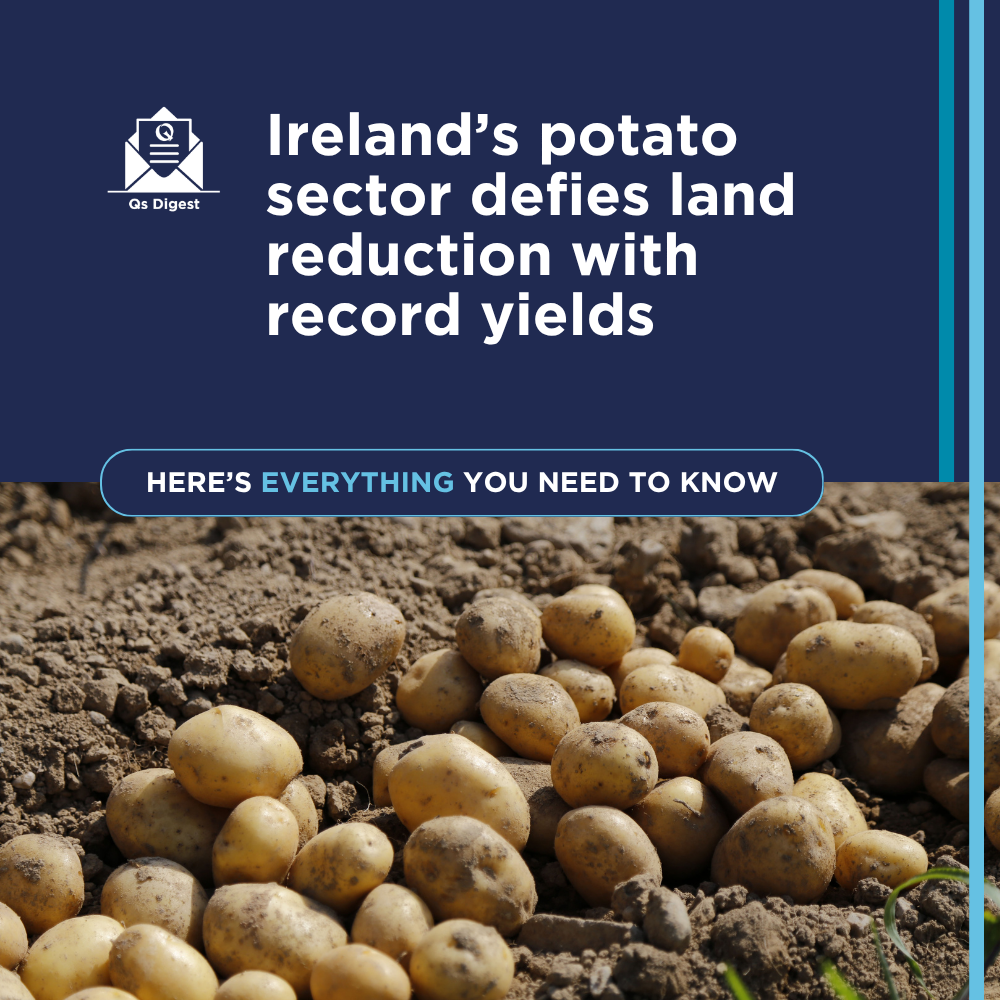
Ireland’s potato sector defies land reduction with record yields
Despite a significant decrease in cultivated land, Ireland’s potato industry continues to deliver steady output through enhanced yields, but experts warn this reliance on productivity growth could threaten sector resilience in future years.
Ireland’s potato sector has managed an unusual feat: it has kept output broadly steady even as the land devoted to the crop has shrunk markedly. According to the Central Statistics Office, production reached 384,900 tonnes in 2025, up 4.5% from the previous year, despite the planted area slipping to 8,900 hectares. Eurostat records a slightly lower figure for the same season, but its data point to the same underlying pattern: fewer hectares, higher productivity and a crop that is increasingly dependent on strong yields rather than acreage.
The improvement in yield is doing most of the work. The CSO said average output rose to 43.1 tonnes per hectare in 2025, compared with 39.6 tonnes a year earlier. Over the longer term, the trend is even clearer. In 2005, Irish farms planted 11,790 hectares and harvested 409,200 tonnes, according to Eurostat. Since then, the area has fallen by roughly a quarter, yet production has stayed within a relatively tight band in most years because farmers have steadily lifted yields above 40 tonnes per hectare. Even so, the sector remains vulnerable to poor seasons, with output dropping sharply in 2012 and 2018.
Teagasc, Ireland’s agriculture and food development authority, says the industry now occupies just over 9,000 hectares, a tiny fraction of the 332,000 hectares used in 1850. It estimates the crop’s farm-gate value at about €85 million a year. The market has also changed on the demand side: average consumption has fallen to about 85kg per person annually, down from 140kg in the 1990s, although potatoes still remain a staple in Irish households. Retail data cited by the agency show sales of €219 million in the 12 months to November 2024, underlining that lower consumption has not eliminated the crop’s commercial importance.
One variety, Rooster, dominates much of the sector. Teagasc says it accounts for about 70% of the maincrop area, while its varietal guidance notes that it commands more than 40% of the total ware area and has become popular because of its taste, cooking qualities and agronomic performance. That concentration is a strength in good years, but it also leaves the sector exposed. Teagasc has warned that if the maincrop area falls much below 7,000 hectares, the economics of storage, grading and marketing could become harder to sustain, making the Irish potato supply chain increasingly sensitive to weather and other shocks.
Align your brand with one of Ireland’s most respected food and drink awards programmes by becoming a Partner today of Ireland's Quality Food & Drink Awards today. Download our Media Pack here: https://irish.qualityfoodawards.com/irelandqualityfooddrinkawards2026/en/page/become-a-sponsor-or-partner